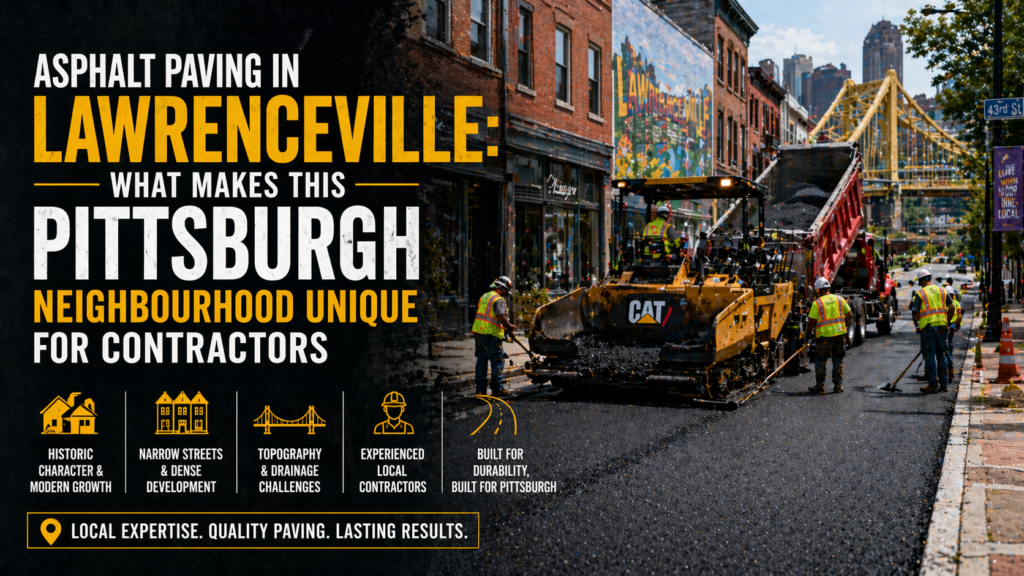
Lawrenceville has undergone one of the most dramatic transformations of any neighbourhood in Pittsburgh. Once a working-class industrial district running along the Allegheny River, it is today a vibrant, mixed-use community packed with boutique businesses, restored rowhouses, breweries, art studios, and busy pedestrian corridors along Butler Street. That transformation has brought with it a surge in demand for quality paving services, as property owners renovate driveways, businesses upgrade parking access, and community infrastructure continues to evolve.
Understanding what asphalt work looks like specifically in Lawrenceville its particular terrain, its older infrastructure, and the expectations of a neighbourhood that blends historic character with modern activity is useful for anyone managing a property or planning a paving project in the area.
Lawrenceville’s Terrain and What It Means for Paving
Lawrenceville stretches through several distinct zones: Lower Lawrenceville near the river, Central Lawrenceville along the main commercial corridors, and Upper Lawrenceville, which climbs toward more residential, hillside streets. Each zone presents its own paving considerations.
In Lower Lawrenceville, proximity to the Allegheny River means drainage and water management are particularly important. Paved surfaces must slope and channel runoff effectively to prevent standing water, which accelerates asphalt deterioration. The relatively flat terrain here is actually well-suited to asphalt installation when base preparation is done correctly.
Moving up through Central and Upper Lawrenceville, gradients increase significantly. Pittsburgh’s characteristic rolling topography means that driveways and access roads often have noticeable slopes. Asphalt on a grade requires careful attention to compaction, thickness, and edge support to prevent the material from shifting or sloughing over time. For residential driveways in particular, getting the grading and drainage right from the start is what separates a surface that lasts two decades from one that fails within five years.
The Age of Lawrenceville’s Infrastructure
Like most of Pittsburgh’s older neighbourhoods, Lawrenceville was built over generations. Much of the subsurface infrastructure water lines, gas lines, sewer systems dates back decades, and ongoing utility replacement and repair work is a regular feature of the neighbourhood’s streets. When Penn Avenue underwent utility infrastructure upgrades, for example, the asphalt paving of the road surface had to follow behind the utility work rather than being planned independently.
This creates a specific paving reality for contractors working in Lawrenceville: streets and surfaces are often disrupted and patched repeatedly over the years, creating uneven or mismatched pavement sections. Property owners with driveways adjacent to utility corridors may also deal with access points that have been cut and patched multiple times.
Quality asphalt work in this environment often involves not just laying new material but carefully integrating new sections with existing pavement, managing transition edges, and ensuring proper drainage is maintained despite the complexity of older subsurface conditions.
Residential Driveway Paving in Lawrenceville
Residential driveways in Lawrenceville vary considerably. Some are relatively standard rectangular lots accessed from side streets. Others are narrow, steeply pitched strips running alongside rowhouses. Some properties share a single paved lane that serves multiple homes a common arrangement in Pittsburgh’s older neighbourhoods.
The key elements of a quality residential driveway installation in this context include:
Proper base preparation The existing surface must be thoroughly assessed before new asphalt is laid. If the base beneath the old surface has deteriorated, simply resurfacing over the top will not solve the underlying problem. A contractor evaluating a Lawrenceville driveway will check for base stability before recommending the appropriate approach.
Correct drainage slope Every driveway needs to be graded so that water flows away from the structure and toward a suitable drainage point. In Lawrenceville’s hillside areas, managing runoff so it does not damage adjacent properties or collect at the bottom of a steep driveway requires careful planning.
Edge restraints and compaction Without properly compacted edges, asphalt will crumble at the perimeter over time, particularly in areas subject to freeze-thaw conditions. A well-finished driveway has clean, dense edges that hold their shape through Pittsburgh’s winters.
Adequate thickness A residential driveway typically requires a minimum of 2 to 3 inches of compacted asphalt over a properly prepared aggregate base. In areas with heavier vehicle access service vehicles, delivery trucks greater thickness is advisable.
Commercial Paving Needs Along Butler Street and Penn Avenue
The commercial corridors of Lawrenceville particularly Butler Street and Penn Avenue generate a different set of paving demands. Business owners need functional, well-maintained parking areas and access points that accommodate consistent traffic from customers, delivery vehicles, and service providers.
Parking lot asphalt in commercial settings is subject to higher stress than residential driveways. Vehicles stop, start, and turn repeatedly, which creates concentrated wear patterns. Delivery trucks impose heavy axle loads. Oil and fuel drips from vehicles can degrade asphalt’s binder over time. For these reasons, commercial asphalt in Lawrenceville is typically specified with greater material thickness and is maintained through regular sealcoating and crack filling programs.
Line striping is another important element for businesses. Clearly marked parking spaces, fire lanes, ADA-accessible spaces, and directional arrows all contribute to the safety and usability of a commercial parking area. Regular re-striping keeps these markings visible and compliant.
The Role of Sealcoating in Extending Asphalt Life
Sealcoating is often misunderstood as a purely cosmetic treatment something that makes asphalt look darker and newer. While it does improve appearance, its primary function is protective. A quality sealcoat creates a barrier against the main enemies of asphalt longevity: water penetration, UV radiation, and petroleum product contamination.
In Lawrenceville’s climate, where Pittsburgh winters bring significant freeze-thaw cycling, a sealed surface is far more resistant to the moisture infiltration that drives crack formation and expansion. Sealcoating is typically recommended every two to three years for maintained asphalt surfaces, depending on traffic levels and exposure.
It is important to note that sealcoating should not be applied to asphalt that has significant cracking or structural damage. In those cases, crack repair and patching come first, followed by sealcoating once the surface is structurally sound.
What Poor-Quality Asphalt Work Looks Like
Understanding the signs of substandard asphalt installation helps property owners in Lawrenceville identify problems early, before they become expensive. Some common indicators include:
Water pooling on the surface after rain indicates improper grading or compaction, meaning the surface was not sloped correctly to direct runoff.
Crumbling or ragged edges within the first few seasons suggest inadequate edge compaction or the absence of edge restraints during installation.
Rapid colour fading asphalt turning grey within months of installation rather than years can indicate the use of recycled or lower-quality material that was not properly specified for the job.
Seams between paving passes that are visible and pulling apart suggest the crew did not properly bond adjacent sections during installation.
None of these problems are inevitable with quality workmanship and appropriate materials. They are, however, common when corners are cut.
Asphalt’s Role in Lawrenceville’s Ongoing Evolution
As Lawrenceville continues to attract new businesses and residents, the quality of the neighbourhood’s physical infrastructure increasingly reflects on its identity. Well-maintained, properly paved driveways and parking areas signal to customers, tenants, and neighbours that a property is cared for. Cracked, pothole-riddled, or poorly drained surfaces create hazards, reduce property values, and contribute to a sense of neglect that runs counter to everything Lawrenceville has worked to become.
Whether for a residential property on a steep side street or a commercial parking lot off Butler Street, quality asphalt work in Lawrenceville starts with a thorough understanding of the site, the soil, the drainage, and the demands the surface will face over time.
Conclusion
Lawrenceville’s unique blend of urban density, hillside terrain, ageing infrastructure, and vibrant community activity makes it one of Pittsburgh’s more interesting environments for Asphalt contractor lawrenceville. The best outcomes come from paving professionals who understand how local conditions affect every stage of the work from base preparation through surface finishing and long-term maintenance. For Lawrenceville property owners, knowing what quality asphalt work involves is the foundation for making smart, lasting decisions about any paving project.